Creative Direction
From Original Art to Award-Winning Product
How five artist commissions became four nationally recognized flooring collections — without losing a single voice.
Mohawk Group
Creative Director
2022–2023
5 artists · Mohawk design team · internal operations

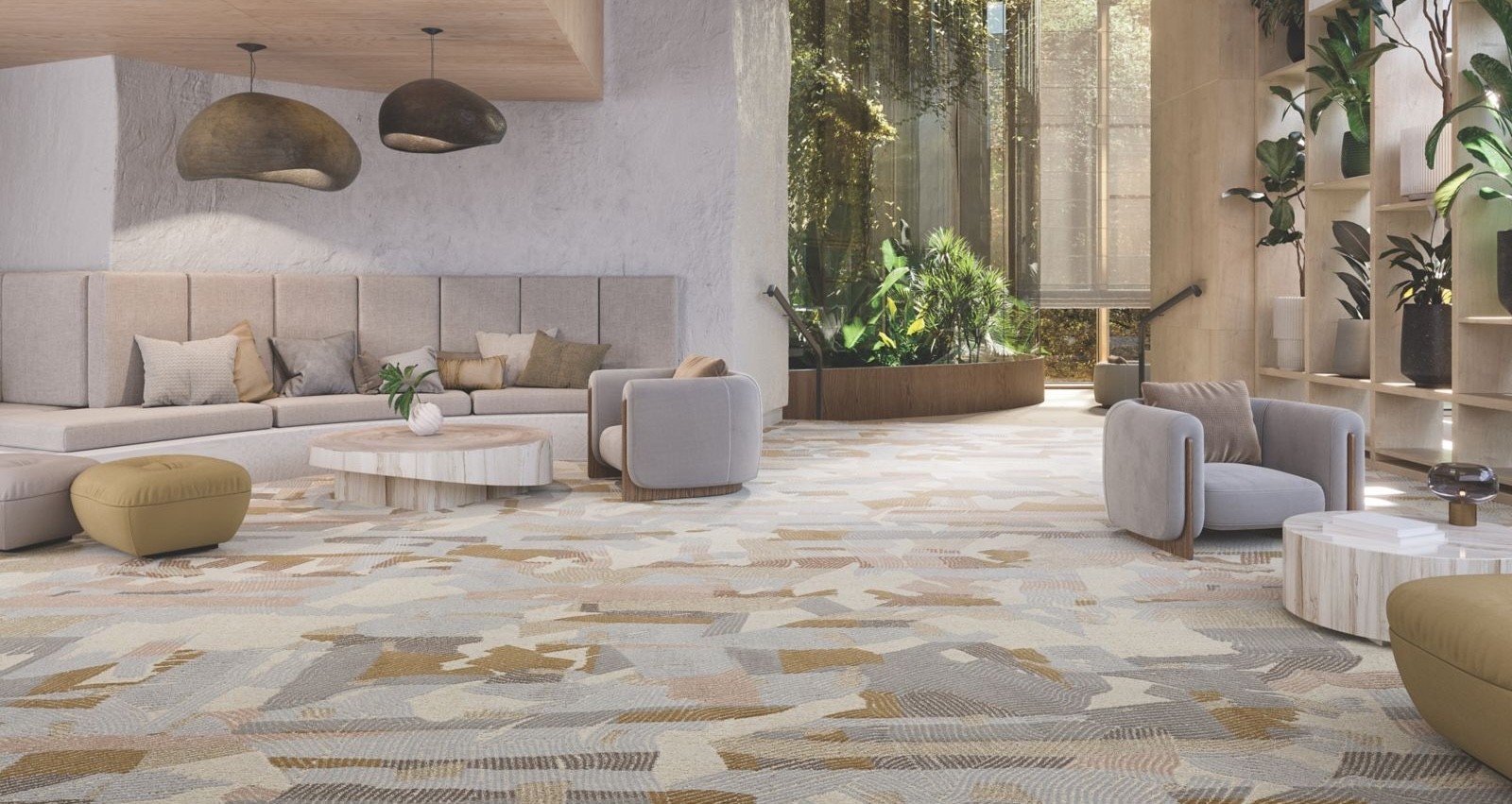
Mohawk Group came to ArtLifting with an ambitious brief: commission five artists to create original works inspired by mycotopia, the interconnected world of fungi, and then translate those works into commercial flooring and carpet collections.
The creative challenge was structural. Mohawk's designers needed to isolate specific visual elements within each artwork — a color field, a compositional rhythm, a textural motif — and deconstruct them into repeatable patterns suitable for manufacturing. That process, by nature, strips away context. A painting becomes a design element. A composition becomes a motif library.
The creative challenge was structural. Mohawk’s designers needed to isolate specific visual elements within each artwork — a color field, a compositional rhythm, a textural motif — and deconstruct them into repeatable patterns suitable for manufacturing. That process, by nature, strips away context. A painting becomes a design element. A composition becomes a motif library.
Each of the five artists worked in a different medium — acrylic painting, digital collage, mixed media — and brought a distinct conceptual approach to the brief. Each was paired with a Mohawk designer who had their own technical constraints around scale, color matching, and pattern repeatability. The artists needed enough creative freedom to produce authentic work. The designers needed enough structure to turn that work into a manufacturable product. Both sides needed someone in the middle who understood what each was asking for and could translate between them.
"My job was to make sure that process didn't strip away the artist."
“My job was to make sure that process didn’t strip away the artist.”
02 · what i built
A structured commission process that held creative integrity and manufacturing requirements in equal measure — across five parallel artist-designer partnerships.
The core design decision was structural: rather than managing five commissions as a single project with a shared creative arc, I ran them as five parallel partnerships — each artist paired with a dedicated Mohawk designer, each following the same stage gates, but with the creative direction tailored to the individual. That structure existed because the brief demanded it. Five artists working in five different media toward a shared theme will not converge naturally. Left unmanaged, the process produces either homogeneity (the designer overrides the artist) or chaos (five disconnected outputs that don't read as a program). The job was to hold the middle — enough shared structure for Mohawk to launch a cohesive collection, enough individual latitude for each artist's voice to survive the translation from original artwork to a repeatable commercial pattern.
The core design decision was structural: rather than managing five commissions as a single project with a shared creative arc, I ran them as five parallel partnerships — each artist paired with a dedicated Mohawk designer, each following the same stage gates, but with the creative direction tailored to the individual. That structure existed because the brief demanded it. Five artists working in five different media toward a shared theme will not converge naturally. Left unmanaged, the process produces either homogeneity (the designer overrides the artist) or chaos (five disconnected outputs that don’t read as a program). The job was to hold the middle — enough shared structure that Mohawk got a cohesive collection launch, enough individual latitude that each artist’s voice survived the translation from original artwork to repeatable commercial pattern.
I guided each artist through the full arc of the commission: interpreting Mohawk's brief, developing their conceptual response, iterating on compositions, and preparing final works for design translation. For some artists this meant helping them navigate a corporate creative process for the first time. For others, it meant protecting a vision that was strong but needed shaping to survive the jump from art to product.
I guided each artist through the full arc of the commission: interpreting Mohawk’s brief, developing their conceptual response, iterating on compositions, and preparing final works for design translation. For some artists this meant helping them navigate a corporate creative process for the first time. For others it meant protecting a vision that was strong but needed shaping to survive the jump from art to product.
The most important part of the role was serving as the bridge between artists and Mohawk's design team. Technical design feedback — about motif isolation, color separation, repeat structures — doesn't land the same way when it's delivered in manufacturing language to an artist who thinks in brushstrokes. I distilled that feedback into constructive, actionable direction: what the designer was really asking for, why it mattered for the product, and how the artist could respond without abandoning their approach.
The most important part of the role was serving as the bridge between artists and Mohawk’s design team. Technical design feedback — about motif isolation, color separation, repeat structures — doesn’t land the same way when it’s delivered in manufacturing language to an artist who thinks in brushstrokes. I distilled that feedback into constructive, actionable direction: what the designer was really asking for, why it mattered for the product, and how the artist could respond without abandoning their approach.
As Mohawk's designers isolated and transformed motifs, I advocated for each artist's voice remaining central to the collection. The goal wasn't to prevent adaptation — that was the point of the project. It was to ensure that the adaptation honored the source. When the final collections launched, each was recognizably rooted in the artist's original work, not a generic extraction of pattern elements.
As Mohawk’s designers isolated and transformed motifs, I advocated for each artist’s voice remaining central to the collection. The goal wasn’t to prevent adaptation — that was the point of the project. It was to ensure that the adaptation honored the source. When the final collections launched, each one was recognizably rooted in the artist’s original work, not a generic extraction of pattern elements.
From Five Artists to Four Collections.
Each collection started as a single original artwork and ended as a manufactured product recognized at the national level. The pipeline below shows the full translation arc — from Mohawk's commission brief through motif isolation, pattern development, and manufacturing. The collections grid shows where each artist's work landed, and which award programs validated the result.
Each collection started as a single original artwork and ended as a manufactured product recognized at the national level. The pipeline below shows the full translation arc — from Mohawk’s commission brief through motif isolation, pattern development, and manufacturing. The collections grid shows where each artist’s work landed, and which award programs validated the result.
Mohawk scope translated into artist language — medium, theme, commercial context
Conceptual response developed — coached through interpretation, intent protected
Full creative ownership — real work, real voice. Not illustration-to-spec.
Technical feedback translated — motif separation, colorway, repeat structure made artist-legible
Mohawk design team builds repeatable patterns — artist ownership advocated through each adaptation
Flooring and carpet production — substrate, scale, colorway finalized
4 named collections, nationally recognized — artist credited in each
brief translation
concept coaching
↑ critical juncture
↑ ownership advocacy
Connie Avery
Abstracted acrylic forms, matsutake-inspired organic complexity.
Gold NeoCon 2023
IIDA/HD Expo
ID Best of Year Finalist
Laria Saunders
Layered digital collage — growth and decay cycles, dynamic running-line collection.
MetropolisLikes 2023
ID Best of Year Winner
HiP 2023
Lindsey Holcomb
Mixed media, root and mycelium networks — benchmark for sustainable flooring.
Gold NeoCon 2023
Sustainability NeoCon
ID Best of Year Finalist
Han Huisman & Michael Van Huffel
Fluid lines and interconnected textures — fungal networks as ecological metaphor.
NeoCon 2023
Commercial translation doesn’t require compromising creative integrity — it requires someone who understands both sides well enough to run the space between them.
technical design language
↓
↓
artist-actionable direction
5 artist-designer pairs managed simultaneously
The collections entered the commercial flooring market as both creative and commercial successes — recognized by the industry's most competitive award programs and adopted at architectural scale.
The collections entered the commercial flooring market as both creative and commercial successes — recognized by the industry’s most competitive award programs and adopted at architectural scale.
artists commissioned
Each worked in a different medium — the process had to flex, not standardize
award-winning collections
Mycotopia, Wild Dyer, Taking Root, Entangled Earth
national design awards
NeoCon Gold, Best of Year, MetropolisLikes, HiP, IIDA/HD Expo
industry reached
Artist work translated to product at industry scale
Commercial translation doesn't fail because the creative is wrong or the commercial requirements are unreasonable. It fails when nobody owns the space between them. The transferable skill isn't taste or technical knowledge — it's the ability to hear what a designer is actually asking for, reframe it in language an artist can act on, and protect the integrity of both sides through every round of adaptation. That's a function, not a feeling. It can be structured, repeated, and taught.
Commercial translation doesn’t fail because the creative is wrong or the commercial requirements are unreasonable. It fails when nobody owns the space between them. The transferable skill isn’t taste or technical knowledge — it’s the ability to hear what a designer is actually asking for, reframe it in language an artist can act on, and protect the integrity of both sides through every round of adaptation. That’s a function, not a feeling. It can be structured, repeated, and taught.
Creative Direction
Artist Development
Client Partnership
Feedback Systems
Cross-Functional Collaboration